FCC Clears 36 Quad-Band Gateways to Supercharge Starlink Toward Gigabit Speeds
Authorization covers ground stations in five US states and prepares the network for V3 satellites, with capacity targets through mid-2027
Pontos-Chave
- FCC approves 36 next-generation gateway ground stations for SpaceX
- Stations located in California, Colorado, Missouri, Texas, and Washington
- Quad-band stations support up to 40 antennas and additional radio frequency bands
- 26 Starlink V3 satellites currently in orbit, with 26 more planned on the next Starship flight
- SpaceX aims for a few hundred V3 satellites by mid-2027
- Iridium withdrew its interference objections after coordination agreement
- One gateway, 'First of Its Name,' excluded from main license but has temporary authorization through January
The U.S. Federal Communications Commission (FCC) has granted SpaceX authorization to operate 36 next-generation gateway ground stations, a step that expands Starlink's backbone in the country. The licenses cover installations in California, Colorado, Missouri, Texas, and Washington.
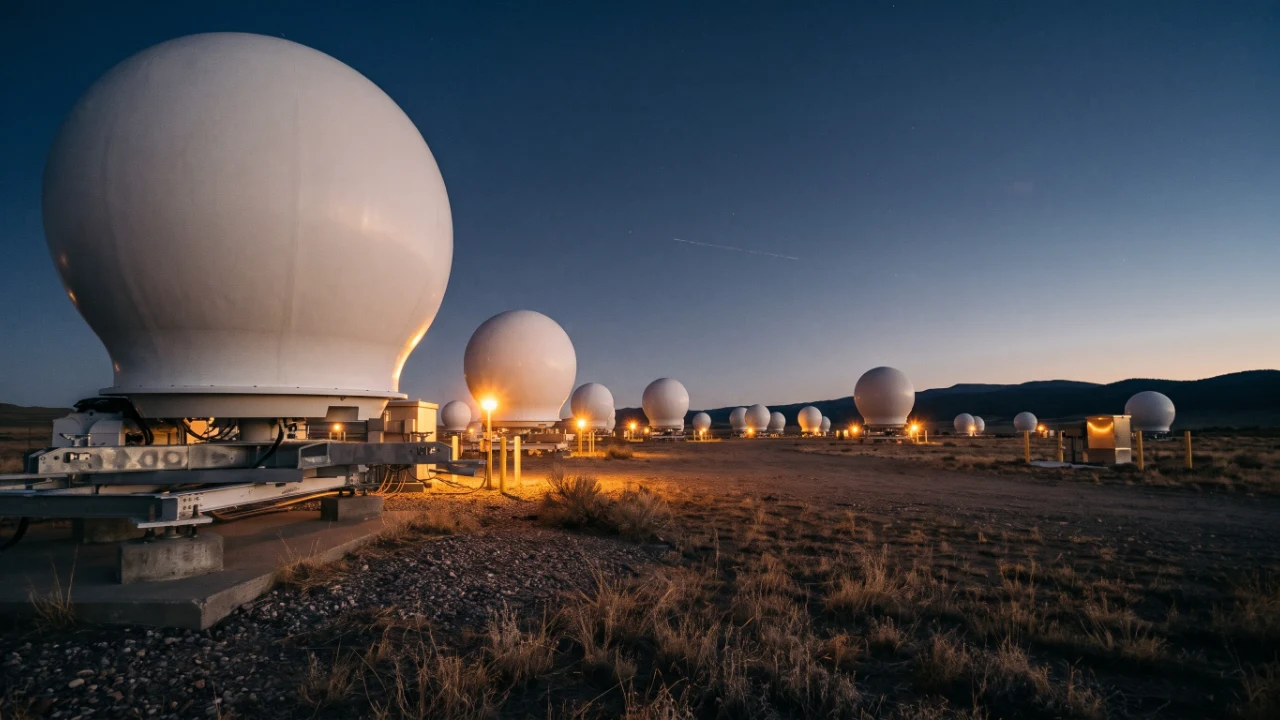
These bases are connected to fiber optic networks and serve as communication points between ground infrastructure and Starlink satellites in orbit. The new equipment is called quad-band stations and was designed to use up to 40 antennas and additional radio wave bands.
The architecture behind gigabit speeds
According to SpaceX's proposal, the technology will enable low-latency broadband and speeds in the gigabit-per-second range, with capacity similar to a fiber optic connection. The expansion is part of a larger project to improve service with the arrival of Starlink V3 satellites.
The new-generation equipment should significantly increase network capacity, benefiting users even without the need to replace their current antennas, provided they are compatible. The company still has a limited number of these satellites in orbit: 26 units as of publication, with another 26 planned for a launch during the next Starship flight.
The timeline declared by SpaceX
SpaceX President Gwynne Shotwell stated that the company will need to place a few hundred V3 satellites into operation for consumers to notice the upgrade's impact. The executive's expectation is to reach that quantity by mid-2027.
Compatibility should also extend to more recent equipment. A SpaceX executive has indicated that V5 and Starlink Mini 2 antennas were designed to work with V3 satellites.
Dispute with Iridium and license limits
The FCC approval came after a dispute involving Iridium, a company that operates its own satellite network. Initially, the company contested SpaceX's licenses out of concern that the new stations would cause interference with its network's communications.
Last month, Iridium withdrew its petitions after assessing that it would be possible to coordinate operations with SpaceX to avoid the problem. The FCC also reviewed the matter and concluded that the proposed stations should not cause unacceptable interference with other satellite networks authorized to operate in the same frequency bands.
Despite the approval of 36 installations, the authorization does not cover all gateways requested by SpaceX. One of the bases, nicknamed "First of Its Name," was left out of the main grant because its application was modified to include an additional frequency band. Nevertheless, it has a temporary authorization to operate until January.
Practical Impact
Starlink's bottleneck is no longer just space but now includes the ground: quad-band gateways with up to 40 antennas raise the density of traffic the network can offload to fiber optics, a necessary condition for V3 satellites to deliver the promised capacity without saturating interconnection points.
In practice, the gain depends on the pace of Starship launches and the deployment of the hundreds of V3 satellites that SpaceX itself considers necessary by mid-2027 — without that critical mass in orbit, the new stations operate below their projected potential.