Data Centers Become a Battleground Between AI, Energy, and Local Communities
Record electricity consumption, competition for water, and local opposition put AI's physical infrastructure at the center of the backlash against Big Tech
Fact Box
- Data centers consumed about 415 TWh in 2024, nearly 1.5% of global electricity, according to the IEA
- LBNL projects data centers will account for 6.7% to 12% of U.S. electricity consumption by 2028
- In Ireland, data centers accounted for 21% of metered electricity in 2023, according to the CSO
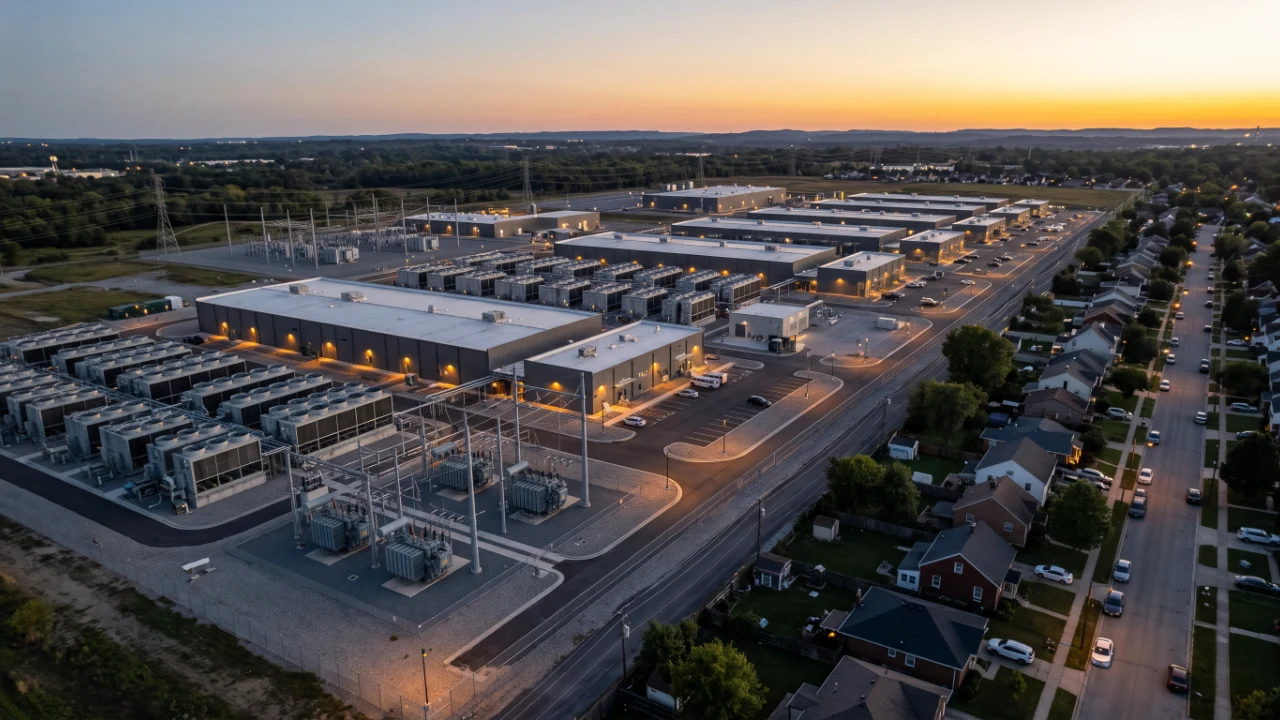
The most visible layer of artificial intelligence is not the model but the warehouse. Concrete blocks with dedicated substations, cooling towers, and reinforced transmission lines are emerging in rural areas and industrial belts—and have become the focus of the political wear that was previously directed at digital platforms.
The reason is simple: AI computing has ceased to be an abstract service in the cloud and has become an industrial load. Each new GPU cluster requires hundreds of megawatts of firm capacity, continuous cooling, and years in the queue for grid connection. It is this materiality that has turned the sector into a target.
Energy Is No Longer a Detail
According to the International Energy Agency (IEA), data centers consumed about 415 TWh in 2024—roughly 1.5% of global electricity—with a projection of reaching nearly 945 TWh by 2030. In the United States, Lawrence Berkeley National Laboratory (LBNL) estimates that the sector accounted for 4.4% of the country's electricity in 2023, with a projected range of 6.7% to 12% by 2028.
Numbers like these change the nature of the business. The data center ceases to be a premium customer for utilities and becomes a structural factor in load planning—with a direct impact on rates, construction schedules, and decarbonization targets.
The Friction Is Local, Not Global
Opposition rarely originates in forums on AI regulation. It appears in municipal hearings on zoning, in counties that discover groundwater consumption, and in neighborhoods that begin living alongside fossil-fuel generators installed to accelerate operations.
Two cases have become reference points. In Memphis, in the United States, xAI's Colossus cluster operated with gas turbines on an emergency basis and faced pushback from local environmental groups. In Loudoun County, Virginia, the world's largest concentration of data centers, data centers already account for more than 20% of Dominion Energy's electricity sales—and the debate over new transmission lines and substations drags on through public proceedings.
Outside the United States, Ireland offers the clearest picture of the aggregate effect: the CSO statistics office reports that data centers consumed 21% of metered electricity in the country in 2023, in an island electricity system with little spare margin.
Who Pays the Bill
The most sensitive point is rate-setting. When a utility needs to bring forward grid upgrades to serve a single giant customer, the cost tends to be socialized across all consumers—unless the regulator imposes special load contracts, with financial guarantees and long terms.
In the United States, this dispute has shifted to state public utility commissions. “Large-load” tariffs, firm-capacity requirements, and termination clauses have entered the agenda in states such as Georgia and Virginia. At the same time, the grid connection queue has accumulated terawatts of pending projects, pushing the industry toward solutions outside the traditional grid.
The Industry's Response
Big Tech responded by buying energy, not just contracting for it. Since 2024, long-term purchase agreements with existing nuclear plants and small modular reactors (SMRs) have multiplied, along with the purchase of entire campuses with on-site generation.
Engineering also entered the calculation. Direct liquid cooling, higher rack density, and more efficient chips per watt reduced relative consumption, but not absolute consumption: each efficiency gain was quickly consumed by larger models and training at scale.
The result is a sector that must simultaneously prove efficiency, finance infrastructure, and negotiate with city governments—a public relations equation far more difficult than launching a product.
Practical Impact
On the technical front, the agenda shifts AI's bottleneck from silicon to the electric grid. Connection restrictions, transformer availability, and substation licensing now define the pace of cluster expansion, not the supply of GPUs.
On the operational front, energy costs and local regulatory requirements are definitively entering Big Tech's financial models. Special load contracts and dedicated generation signal that competitiveness in AI will increasingly be a contest over physical infrastructure and social license to operate.