FCC authorizes SpaceX to launch up to 1 million satellites with AI chips
Unprecedented approval from the U.S. agency requires the first Starmind satellite by 2033 and 1 million units in orbit by 2040
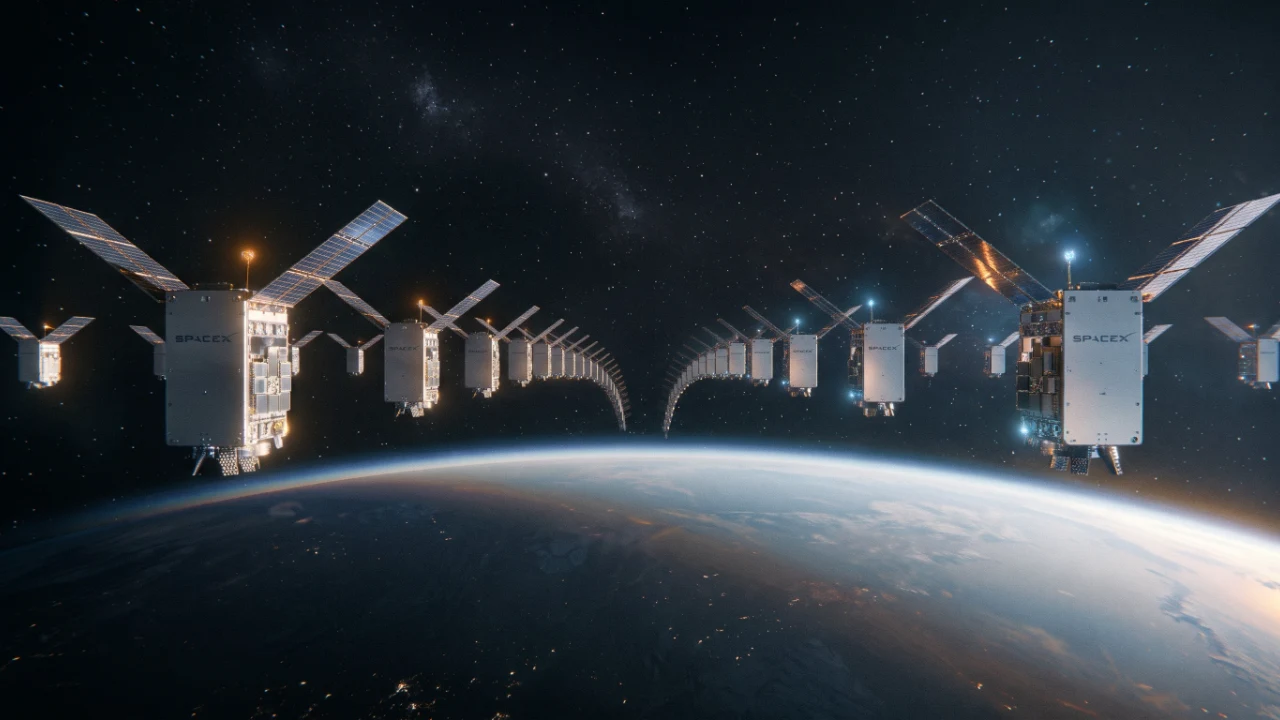
Approval fact box
- FCC requires at least one Starmind satellite in orbit by 2033 and 1 million units by 2040
- Request to dispose of satellites in graveyard orbits above 600 km was postponed for lack of information
- Chips will be manufactured at the future Terafab facility; data reaches Earth via lasers linked to Starlink
The U.S. Federal Communications Commission (FCC) has authorized SpaceX to operate up to 1 million satellites equipped with artificial intelligence chips. The green light was announced on Wednesday (25) and is the first license granted by the U.S. agency for a complete constellation dedicated to AI computing in orbit.
The venture was named Starmind within Elon Musk's company. Until now, the FCC had approved communications constellations and isolated experiments with space-based servers — never a swarm of satellites designed to process inference outside the atmosphere.
Deadlines and mandatory milestones
The license is not a blank check. SpaceX must place at least one Starmind satellite into orbit by 2033 and reach 1 million units by 2040. Both commitments serve as conditions for maintaining the license.
The agency also decided to postpone a specific request from the company. SpaceX wanted authorization to dispose of satellites positioned above 600 km in altitude in so-called "graveyard" orbits, where decommissioned equipment remains parked indefinitely instead of burning up on atmospheric reentry. The FCC justified the refusal by stating that the company had not provided "sufficient information" about its disposal plans.
How Starmind intends to operate
The architecture described by SpaceX combines solar power collection in space with processing in orbit. According to the company, the goal is to "capture solar energy in space to power" AI capabilities on Earth — a model that avoids pressure on terrestrial power grids and reduces dependence on conventional cooling.
Transmission of results to the ground would be carried out by high-speed lasers connected to the Starlink network, the broadband internet constellation already operated by the company. The chips used in the satellites, meanwhile, are expected to come from a future facility named Terafab, whose operating timeline was not detailed in the announcement.
The race for computing beyond Earth
Starmind is not alone. Google took the first steps in the same direction with the launch of an AI server satellite from "Project Suncatcher" last month. Jeff Bezos's Blue Origin will be responsible for the project's first dedicated heavy-lift launch, scheduled for 2029.
The difference in scale is what makes the FCC decision relevant. While competing initiatives are still testing single prototypes, SpaceX has obtained regulatory authorization for an industrial-scale constellation — shifting the discussion from technical feasibility to the realm of orbital governance and space traffic control.
Practical impact
From an engineering standpoint, the bottleneck is no longer launch but energy density per satellite: generating, converting, and dissipating heat in a vacuum requires thermal designs radically different from those of terrestrial data centers. The laser connection to Starlink also turns the broadband constellation into a data backbone for distributed inference.
On the operational front, the authorization creates a regulatory precedent for orbital data centers and increases pressure on equipment disposal rules. The postponement of the request for graveyard orbits above 600 km signals that the FCC intends to treat orbital sustainability as a licensing condition, not as an afterthought.