Microsoft Elevates Copilot to the Operating System of Work in the Age of Agents
At Ignite 2026 in San Francisco, the company unveils Work IQ, Microsoft IQ and Copilot Workspaces to orchestrate agents at enterprise scale
Ignite 2026 Fact Sheet
- Copilot brings together Chat, Cowork, Code and Autopilot into a single work layer
- Work IQ connects Fabric, Foundry and Microsoft 365 with hundreds of new enterprise connectors
- Windows endpoint security platform moves protections out of the kernel with seven integrated vendors
Microsoft has repositioned Copilot as the central layer of corporate work. Opening Ignite 2026 in San Francisco, United States, Chairman and CEO Satya Nadella presented on Tuesday (17) the thesis of a "frontier ecosystem": a stack built to convert exponential advances into concrete operational results.
The proposal rests on three architectural principles laid out by the executive: keeping human ambition at the center, ensuring that every organization controls its own intelligence and learning, and sustaining everything on trust.
Four formats, one single experience
Under the label of "Copilot as the new operating system of work," the company unified four forms of interaction — Chat, Cowork, Code and Autopilot — into a single environment. The logic is to erase the boundary between knowledge work, programming and business process.
That is why all of Office, with its wealth of features, has been embedded in Copilot. At the base of the arrangement is a model system that matches the right intelligence to the context, the interaction format and the task to be accomplished.
Each format has a defined role: Code works as an infinite SaaS factory, allowing anyone to build their own applications and dashboards. Autopilot is described as an autonomous agent that keeps work moving forward 24 hours a day in the environments where the team collaborates.
Work IQ: the map of corporate context
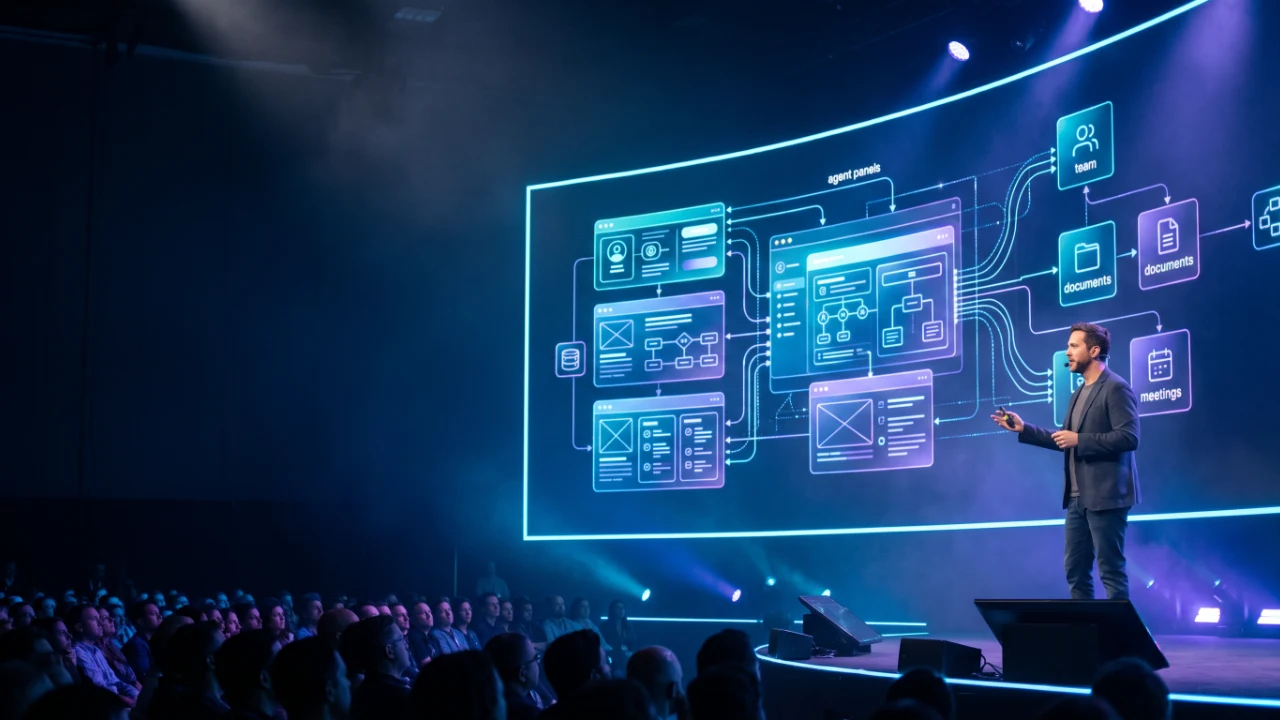
The substrate of it all is Work IQ, presented by Nadella as "the most important database of any organization." It encompasses people, their relationships, documents, emails, meetings, chats and projects that form the fabric of daily work.
From that layer, Microsoft extended Copilot into specific functions — sales, legal, finance and customer service — organizing skills, connectors and plugins across the entire product surface, including third-party systems.
The most relevant move for the corporate market is the integration of business applications. The company announced new plugins starting with Dynamics 365 and confirmed a partnership with Salesforce to bring the CRM platform into Copilot.
From the individual agent to group work
Microsoft IQ externalizes the system that runs under Copilot as a first-class platform, gathering data from Fabric, Foundry and Microsoft 365, plus third-party context. The package includes hundreds of new connectors and turns that context into plugins that can be shared and inherited across the organization.
Nadella also pointed to the limit of the current model: until now, the world has been "single player," with people and their own cycles of agents. The next step is Copilot Workspaces, a multiplayer format in which people, their agents and other people pursue a common goal with shared context.
Windows bets on resilience and least privilege
In a parallel post the same day, Microsoft detailed the security foundation underpinning this stack. Windows runs critical work on more than 1 billion devices worldwide — and, according to the company, the priority is to harden the platform.
The Windows endpoint security platform has reached general availability and lets vendors move critical protections from kernel mode to user mode, reducing the risk that a single failure affects the entire device. The partner list includes Bitdefender, CrowdStrike, ESET, SentinelOne, Sophos, Trellix and TrendAI.
Two other fronts accompany the announcement. Windows baseline protection, in preview in the Windows Insider program, groups secure boot, virtualization-based security and memory integrity into a single verifiable state. Windows administrator protection, now generally available, makes local administrators operate by default with standard user privileges, with elevation granted by Windows Hello only for the specific task — and revoked once it ends.
Practical Impact
Technically, the move transforms Copilot from an interface into a data platform: Work IQ works as a semantic layer over Fabric, Foundry and Microsoft 365, and Microsoft IQ exposes it as reusable infrastructure. The routing of tasks to different models, driven by cost, shifts competition to the quality of context, not just the model.
Operationally, inheritable plugins and the multiplayer format of Copilot Workspaces reduce the effort of integrating agents into systems such as Dynamics 365 and Salesforce. In security, moving protections out of the kernel and standardizing least privilege shrinks the failure surface across corporate fleets — a practical condition for scaling agents without risk and cost growing faster than the value delivered.